

It’s reasonable to expect AI to be very good for the world’s poor. After all, the last wave of technological advances we’ve seen — the internet, the mobile phone — was transformative for lower-income countries. Many countries leapfrogged over infrastructure they’d never built and accessed a massive virtual world of opportunity. In much of sub-Saharan Africa, fewer than one adult in fifty had a landline, and yet mobile networks spread to roughly half the region’s adults within two decades. In Kenya, the mobile-money system M-Pesa lifted an estimated 194,000 households (about 2% of the country) out of poverty, and the poorest gained the most, women especially.
But this is not the case of AI for low- and middle-income countries, which lack the necessary resources to make use of it. Where AI does work, it targets just a sliver of LMIC industries — and, really, those already best off. The things holding back health and prosperity in these countries also often aren’t what’s targeted by AI. And, of course, the largest returns of all belong to the handful of countries that own the technology rather than those who use it.
Missing complements
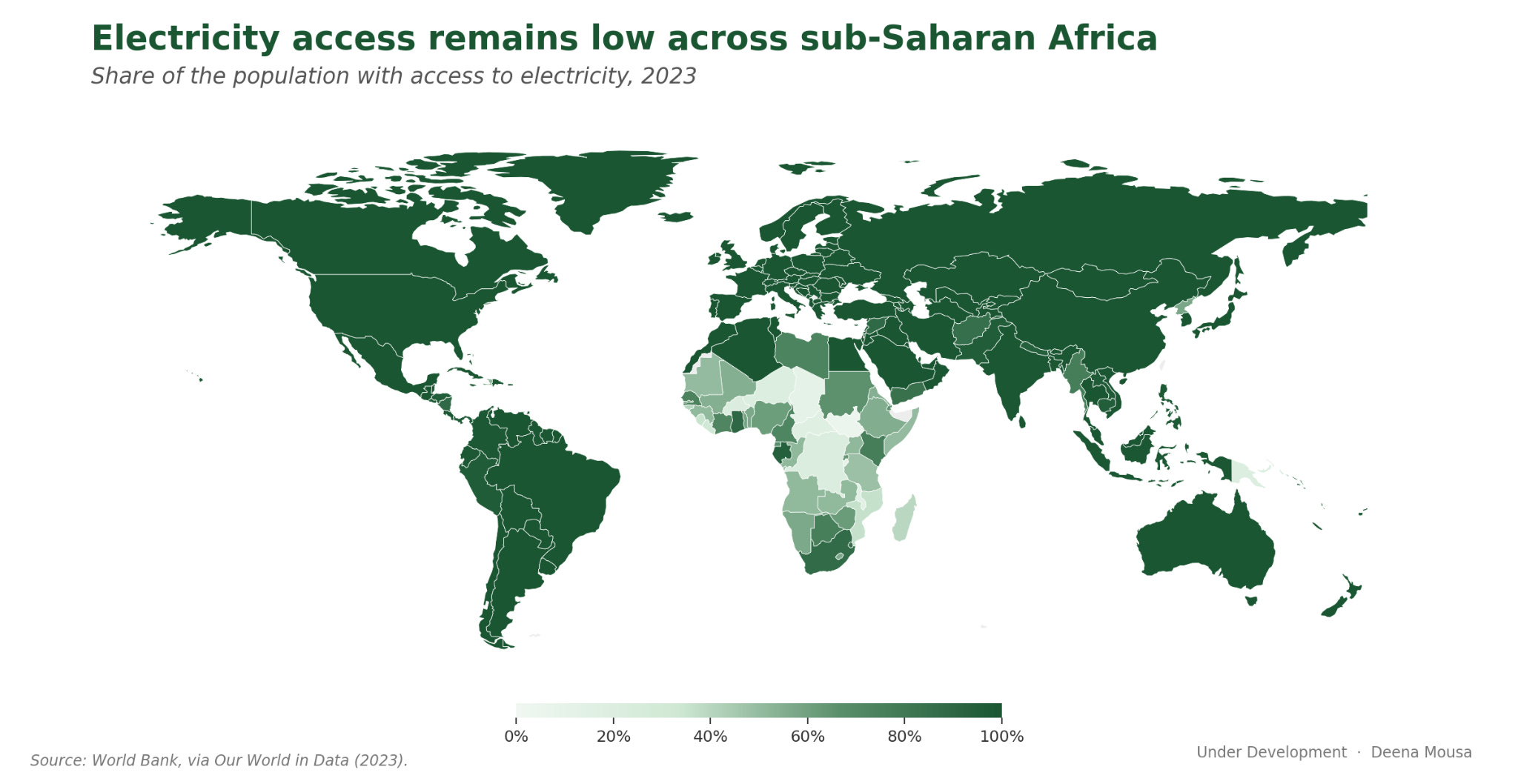
AI doesn’t operate in a vacuum: it requires a set of core complements to be of use. This includes some physical pieces that we take for granted in high-income countries, like consistent electricity, access to computers or mobile devices, and good internet (at least for frontier models). About 600 million people in sub-Saharan Africa lack access to electricity, roughly half the region’s population, let alone reliable and consistent power. And while 13% in the region live outside any mobile broadband signal, another 60% live within range of one but do not use it. An entry-level internet-enabled device costs the poorest fifth of the region’s population about 99% of their monthly income
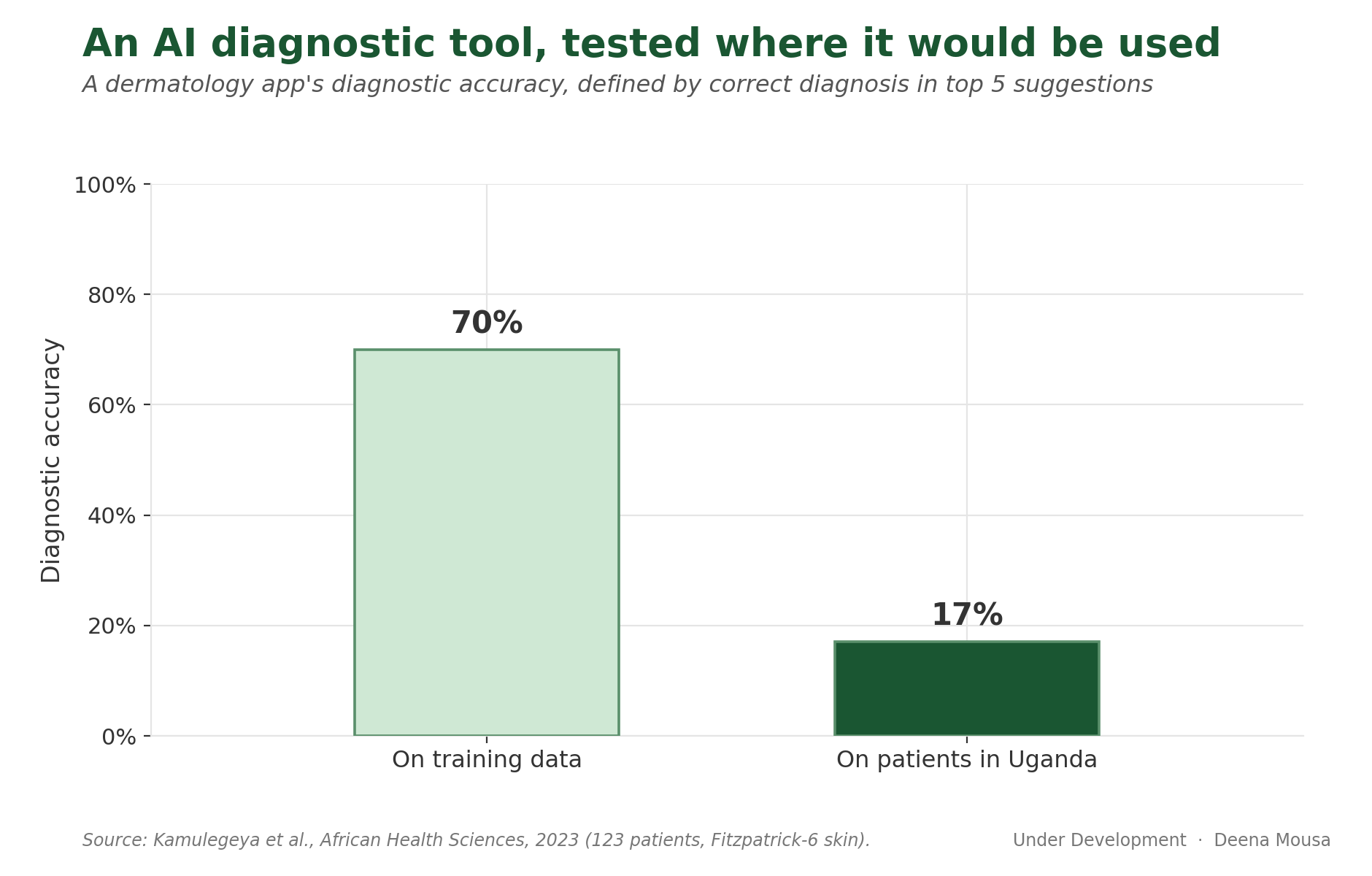
AI also eats data, and is significantly less accurate when used in settings other than those it was trained on. For example, a tuberculosis detection model validated elsewhere flagged only about 25% of the abnormal X-rays in a South African screening study. For some neglected tropical diseases that afflict the world’s poorest, like Buruli ulcer, yaws, and leprosy, 2025 foundation models scored under 20% on a new West African dataset, because these conditions are so rare in the data AI learns from. A dermatology app whose developers reported roughly 70% accuracy on their own (largely light-skinned) data placed the right diagnosis in its top five just 17% of the time when researchers tested it on dark skin in Uganda, and 0% of the time for fungal infections, the single most common condition in the sample.
In many low- and middle-income countries, the data needed to make AI of use doesn’t exist or is still in pen and on paper. In a 2024 survey of doctors in Bangladesh, for example, just 5% kept patient records digitally while more than half were still on paper. This is also true for models’ general abilities to operate in languages other than English. As I wrote recently in The Economist, the vast majority of training data for frontier models is in English and, as a result, they underperform in other languages.
Even when using AI, firms need the organizational capacity to act on what AI produces. A model can hand a firm a better forecast or a leaner process, but capturing the gain means reorganizing how people work, and executing on that is not necessarily straightforward. In a randomized experiment with Indian textile firms, even free, hands-on consulting raised productivity 17% only slowly, and most firms never adopted the freely available practices on their own because good management is tacit. That is, it’s absorbed by doing, and it’s much harder to download it through general written instruction. AI can provide a recommendation but not the capacity to execute on it.
One counterargument to this point is that AI, as a sufficiently useful technology, will induce demand for its own complements. If electricity becomes a critical binding constraint to massive economic growth via AI use, for example, funding from all sources will flow toward creating it. But bottlenecks don’t tend to bite one at a time, and when multiple blockers stand in the way fixing just one doesn’t yield much, resulting in limited incentive for investors to act on it. And electricity has been “useful enough” for 140 years and 600 million Africans still lack it, so usefulness alone has never been sufficient to summon the inputs a technology needs.
Less to amplify
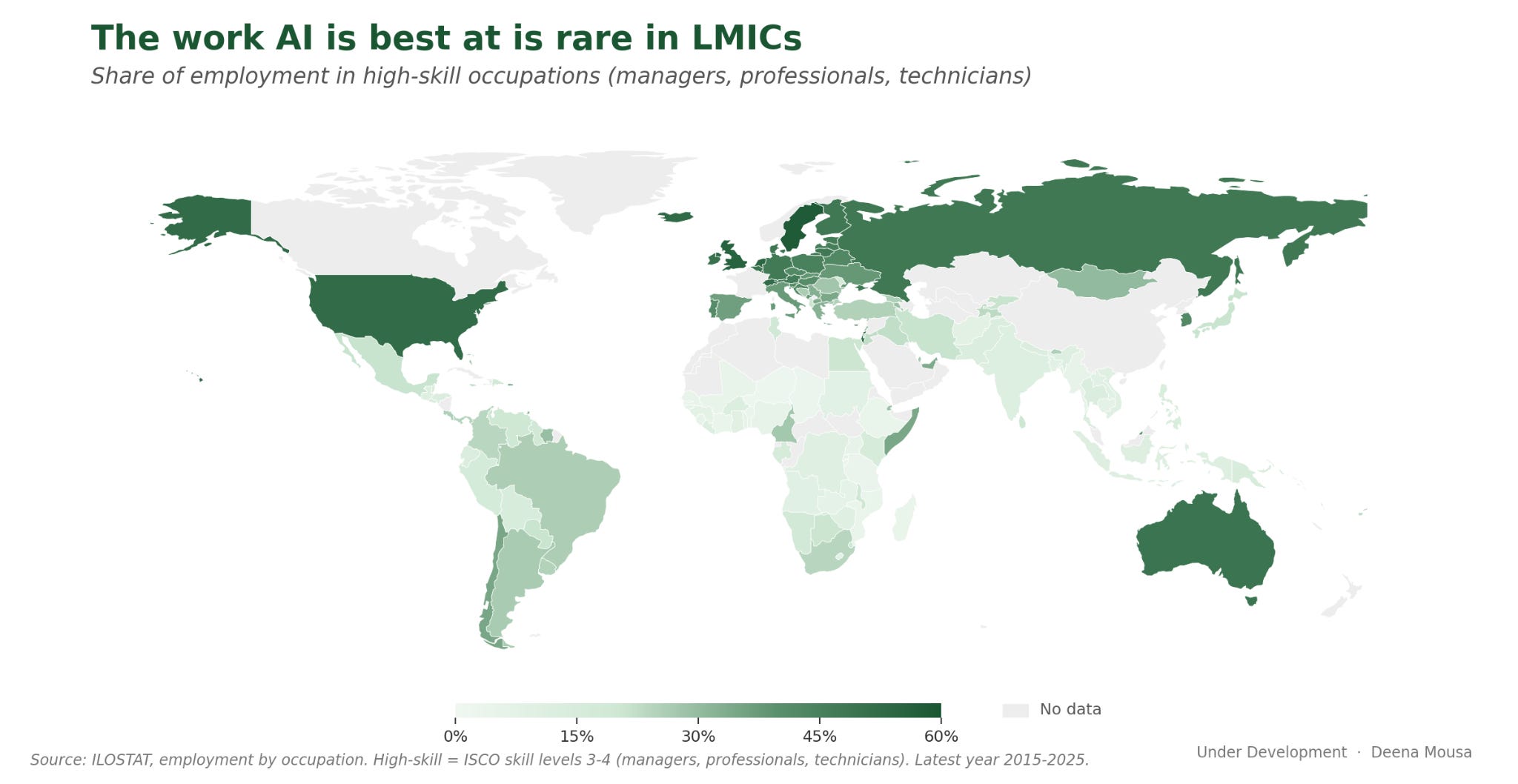
AI boosts productivity the most in white collar knowledge work, and this is overall a very small slice of low- and middle-income economies, both overall and relative to high-income countries.
In a study of which jobs AI could do best, the highest-exposure occupations were knowledge work like coding and analysis, while physical and manual jobs scored lowest. But that work is a small slice of poor economies: in low-income countries about 57% of workers are in agriculture and only a third in services, while in high-income it is roughly 74% in services and just 3% in farming.
The optimistic reading is that this spares poor countries from labor market disruption. If there’s less of a white-collar workforce to automate, fewer jobs will be lost. But the mechanism by which AI raises productivity and induces growth is that disruption. No exposure means no displacement, but it also means no boom.
Another objection is that, because cognitive workers are scarce in poorer countries, AI making the few more productive is much more impactful. For example, if there are fewer radiologists, each serving many more people matters much more than in rich countries without this scarcity. This matters quite a bit for human welfare but welfare gains and economic prosperity aren’t the same thing, and whether a more productive radiologist actually changes health outcomes depends on what was limiting those health outcomes in the first place, as I’ll get to in a moment.
Alternatively, some might argue the window during which AI works alongside humans rather than autonomously is short, and so LMICs don’t need an existing white collar workforce to have an automated one in the future. However, this cuts the wrong way: if AI no longer needs humans in the loop, it no longer needs local humans in the loop either — and the value flows to whoever owns the systems, not to the country that hoped to host the work.
The bottlenecks are elsewhere
In order to understand whether AI will actually solve a particular problem, you must first understand why that problem exists in the first place. For many core issues in LMICs, the rate limiting factor isn’t anything that AI provides.
For example, after the Green Revolution, agricultural yields per hectare rose significantly. But for some smallholder farmers this only translated shakily and inconsistently to greater incomes, in large part because what limited them wasn’t agronomic knowledge but rather things like access to credit or markets. A review of randomized evaluations of agricultural extension found that programs often raised farmers’ knowledge and even their adoption of new practices but effects on yields and profits were inconsistent. This was often due to the same downstream factors, like a lack of credit to buy the inputs, or no market to sell the surplus yields.
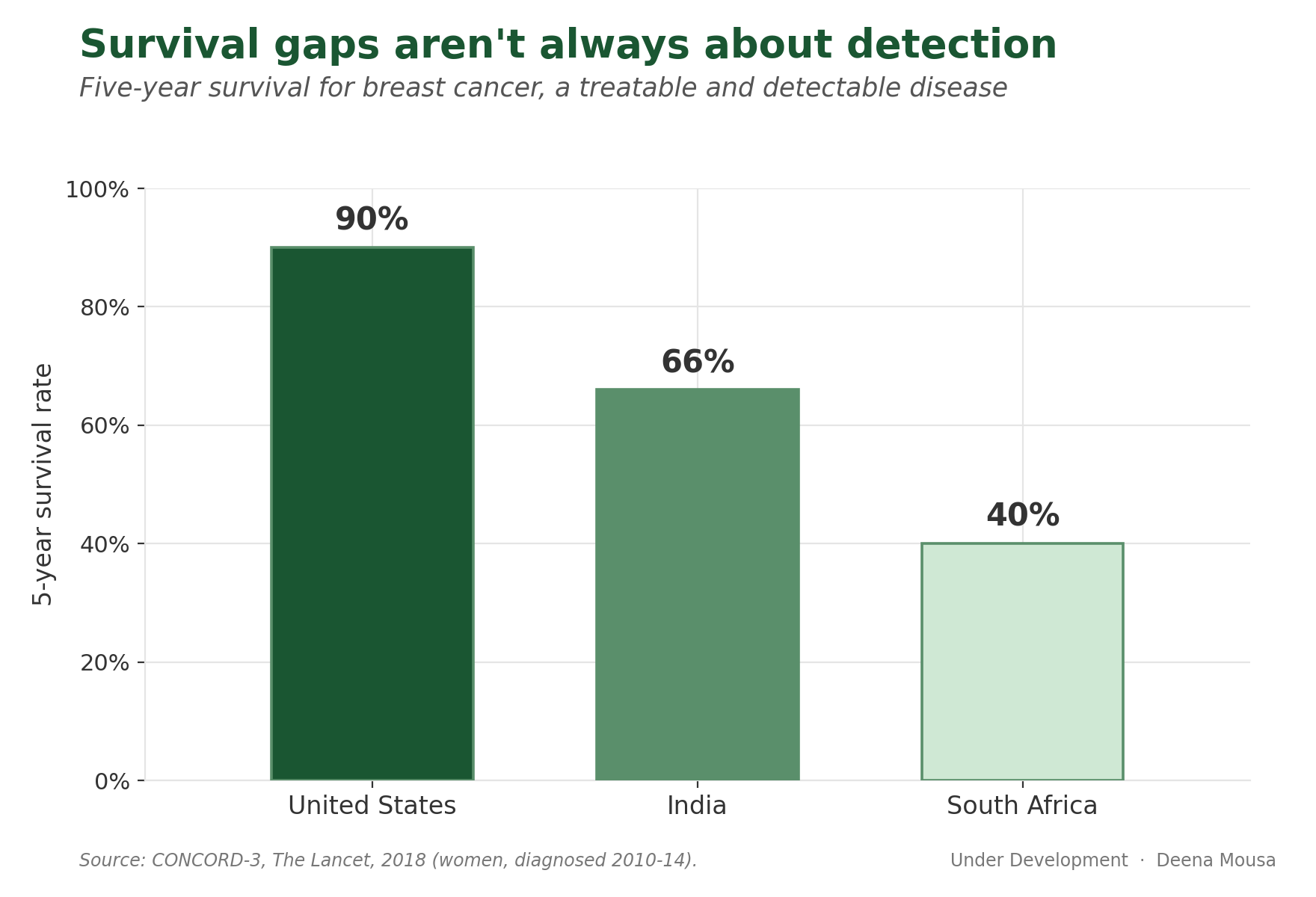
AI can read a scan and flag a tumor as well as a specialist, at least according to benchmarks, but this doesn’t change much in places where chemotherapy drugs are scarce and unaffordable, and radiotherapy machines rare. Five-year breast-cancer survival runs around 90% in the United States versus 40% in South Africa but early AI detection doesn’t seem like it’d do much to close that gap.
The same logic holds in obstetrics, where AI-enabled ultrasound now lets a midwife detect a high-risk pregnancy without a sonographer. This is great, but a flagged emergency still needs a facility with a surgeon, blood, and power that is reachable in time.
The same logic I explored in Malawi applies broadly: the binding constraints in most poor countries are political and structural rather than informational. Certainly, sometimes the skills AI provides does address the key bottleneck, but it’s often the case in lower income settings that there are other obstacles.
The gains are unevenly distributed
All this aside, what gains do accrue aren’t spread evenly. Rather, they generally go to those with more resources to capture them, even within LMICs. Turning again to the Green Revolution as an example: high-yield seeds were, in principle, available to everyone, but a review of studies found that inequality rose, both between farms and between regions.
AI’s early diffusion already shows the same pattern. Adoption is skewed heavily toward the richest and most highly educated both between and within countries. Anthropic’s usage data tracks national income closely: Claude use per person runs about 4.6 times its population share in Singapore but 0.27 times in India and 0.2 times in Nigeria.
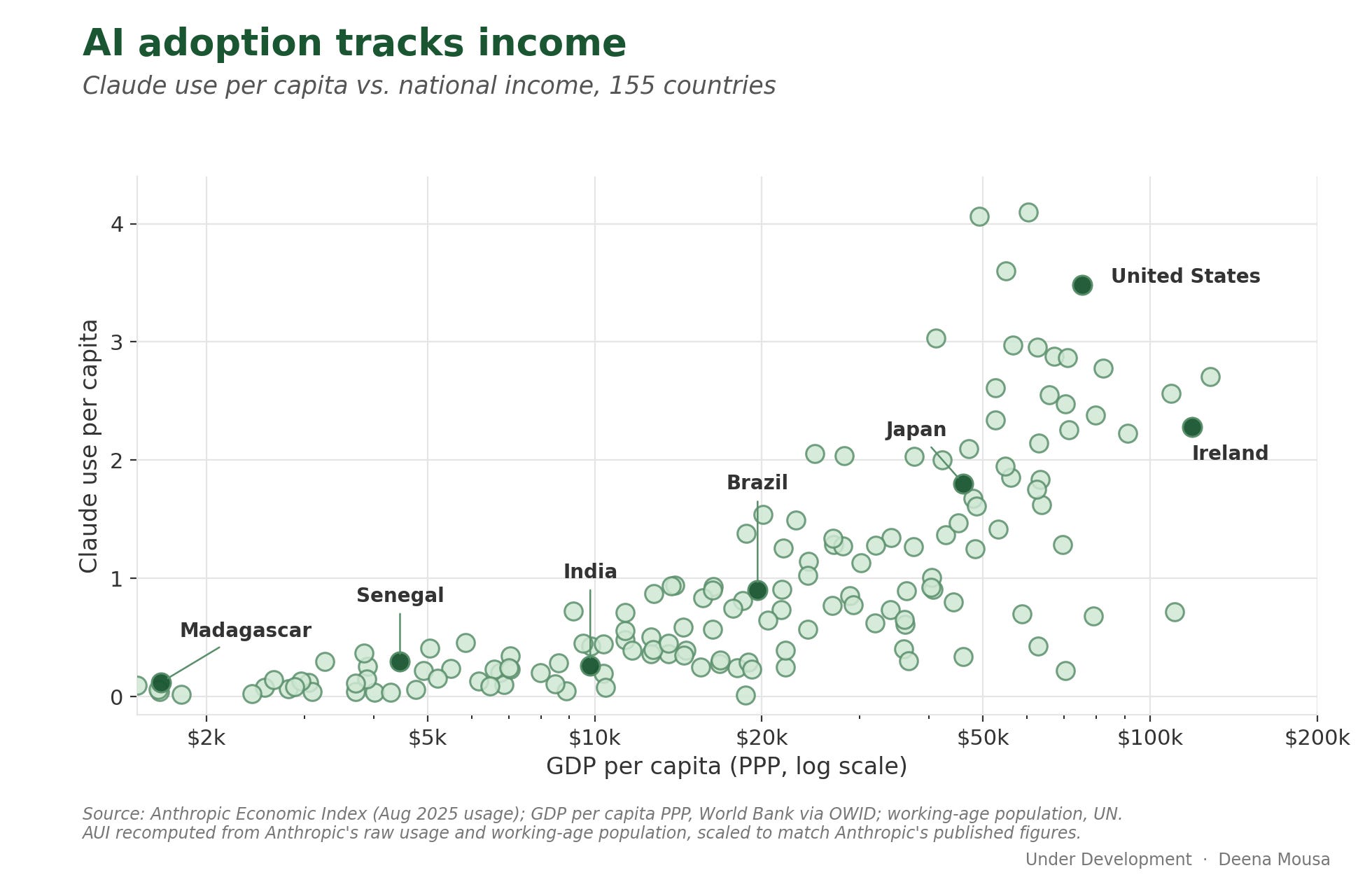
This matters in two ways. First, it makes any national average somewhat misleading. A headline productivity figure can rise while most people do not actually benefit, because the gain is captured by a thin slice of the population. Second, it widens relative gaps between firms, regions, and countries even if no one is made absolutely worse off.
One response is to say this is a temporary part of technological diffusion. The Green Revolution eventually reached smallholders, mobile phones went universal, and AI will too. However, even as access diffuses, it’s the gains that remain unequal, based on pre-existing resources, and — even so — a lag in diffusion itself locks in advantages, dependencies, and political-economy facts that don’t reset just because access equalizes later.
Access or ownership
Everything so far concerns the gains from using AI, but there is a bigger point here: the productivity gains from AI usage pale in comparison from the benefits of having created and owning a frontier model.
The US and China together control ~90% of the computing power needed to develop and deploy frontier AI, and own all fifty of the top-ranked foundation models. Hyperscalers are projected to spend on the order of $690 billion on AI capital investment in a single year, which is a sum no low- or middle-income country could consider. The rest of the world becomes net importers of intelligence, capturing limited downstream gains while exporting economic rents that flow to a couple of countries.
Mobile money worked for low- and middle-income countries because the tool fit its setting, it relieved the constraint that was actually binding, and the gains stayed with the people who needed them. AI doesn’t work the same way. None of this means AI makes poor countries poorer in absolute terms.But much of the gains, and the ownership of what generates them, will settle where the capacity to build and absorb already is.
This is the first article in a series on what LMICs should do in response to AI’s trajectory.
Very good article. One question I’m curious for your take on: I could see a story where AI actually benefits LMICs if it commoditizes a lot of intellectual and managerial work, making physical work relatively more important.
Do you think that’s a possibility? Or do you think the gains from that shift would mostly accrue to higher income countries with strong industrial capacity and institutions?
Very informative article, thank you