

On February 28, 2024, the world’s largest call center company lost over a quarter of its value in a single morning, after an announcement from Swedish fintech Klarna that its AI assistant was now handling two-thirds of its customer service chats. Traders were pricing in a longer-term prediction: that companies selling relatively simple tasks from lower-wage countries to higher ones are at significant risk of automation.
Were they right? In an age of AI, will the world still need what poor countries sell?

One way up
It’s popular to think of economic development like a ladder. As they climb the rungs, economies move from relying on agriculture, to manufacturing, to services. When countries become more productive at each industry, they need fewer and fewer workers to produce outputs that sate demand. And so, rather than the entire population engaging in subsistence agriculture, for example, a smaller subset more productively grows the same crops, while the rest move on to manufacturing goods.
Every country that has sustained rapid growth since 1950 has done so through exports, which allow them to sell goods or services created with cheaper labor to people in wealthier countries, arbitraging the difference in wages. South Korea, for example, went from an income per capita of $100 to over $35,000 within a single lifetime by moving through a series of exports — wigs, plywood, clothing, ships, steel, cars, and, finally, semiconductors.
Without exports, it becomes much more difficult to move up the ladder. For one, a country’s own consumers are usually not sufficient to stimulate growth, both in sheer size and in pre-existing wealth. For another, changing an industry mix is import-intensive, requiring new inputs to production that are often invoiced in strong currencies. Countries must either export, borrow, or rely on remittances in order to have those currencies on hand, and borrowing without exporting can lead to drawing down reserves and default, as Sri Lanka showed in 2022.
Finally, exporting directly improves productivity through learning gains. In one study, researchers randomly allocated foreign orders across small Egyptian rug workshops. Those that sold abroad reported 16-26% higher profits and eventually produced measurably better rugs in spite of using the same looms and materials. Their customers set high standards for the product and created feedback loops that improved the weavers’ process.
Factories without workers
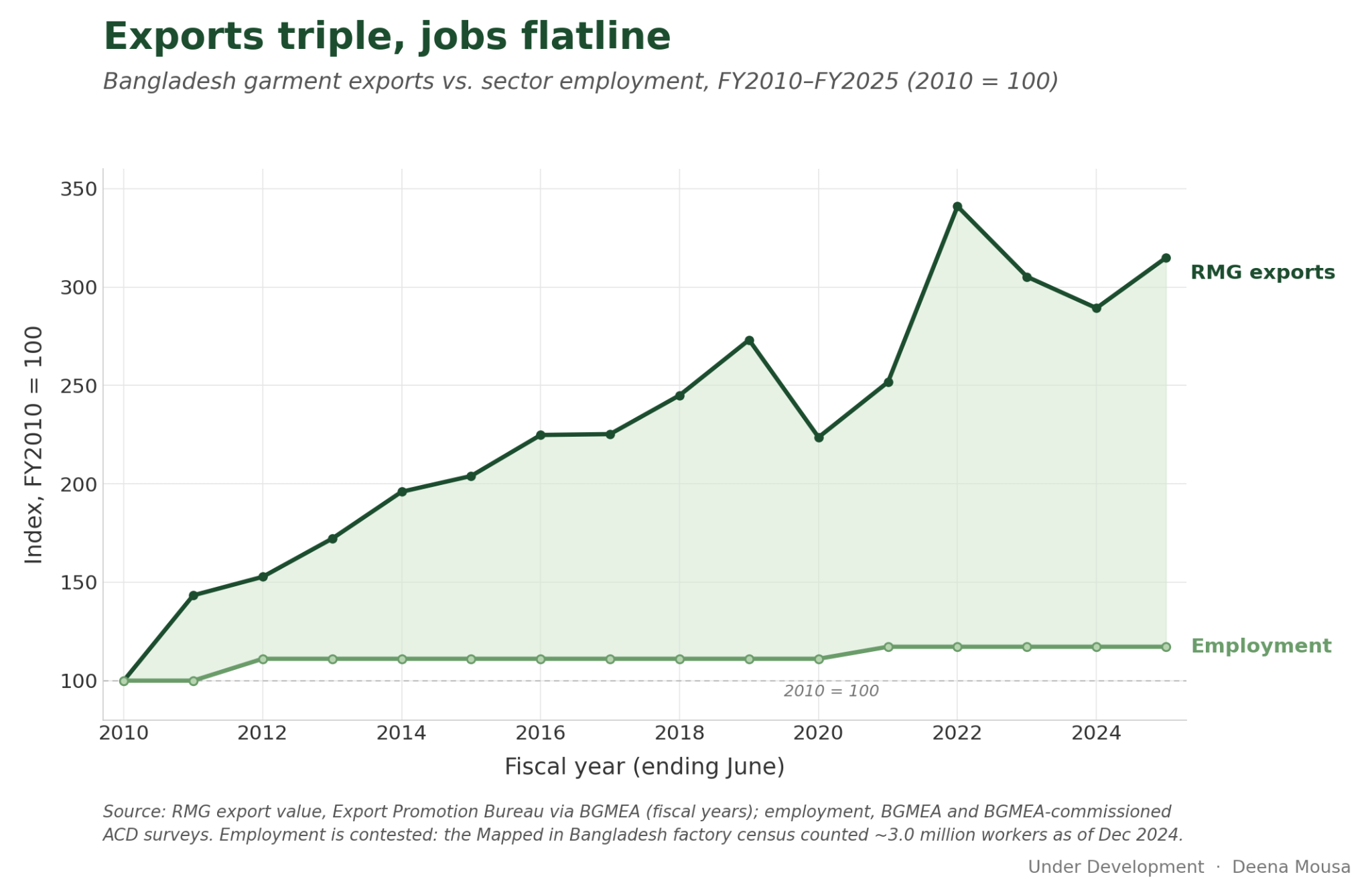
Manufacturing as a path out of poverty is already breaking down. Globalization has resulted in more competition, and China has established some dominance. At the same time, there’s been some automation of factories that makes those jobs scarcer and more skill-intensive. This means that some countries, many in Latin America and sub-Saharan Africa, are pushed out entirely, while those that remain competitive, mainly in Asia, get fewer jobs out of it. For example, Bangladesh’s garment exports tripled between 2010 and 2024, but employment in the sector stayed flat.
As a result, the share of a country’s employment that is manufacturing now peaks at a much lower figure (and at a much lower GDP per capita) than it used to. For first-movers like Britain, Sweden, and Italy, manufacturing jobs only started to decline at around $35,000 per capita (in today’s dollars), whereas India and much of sub-Saharan Africa hit the same point at about $1,800 per capita. It’s likely that future automation will just accelerate this trend.
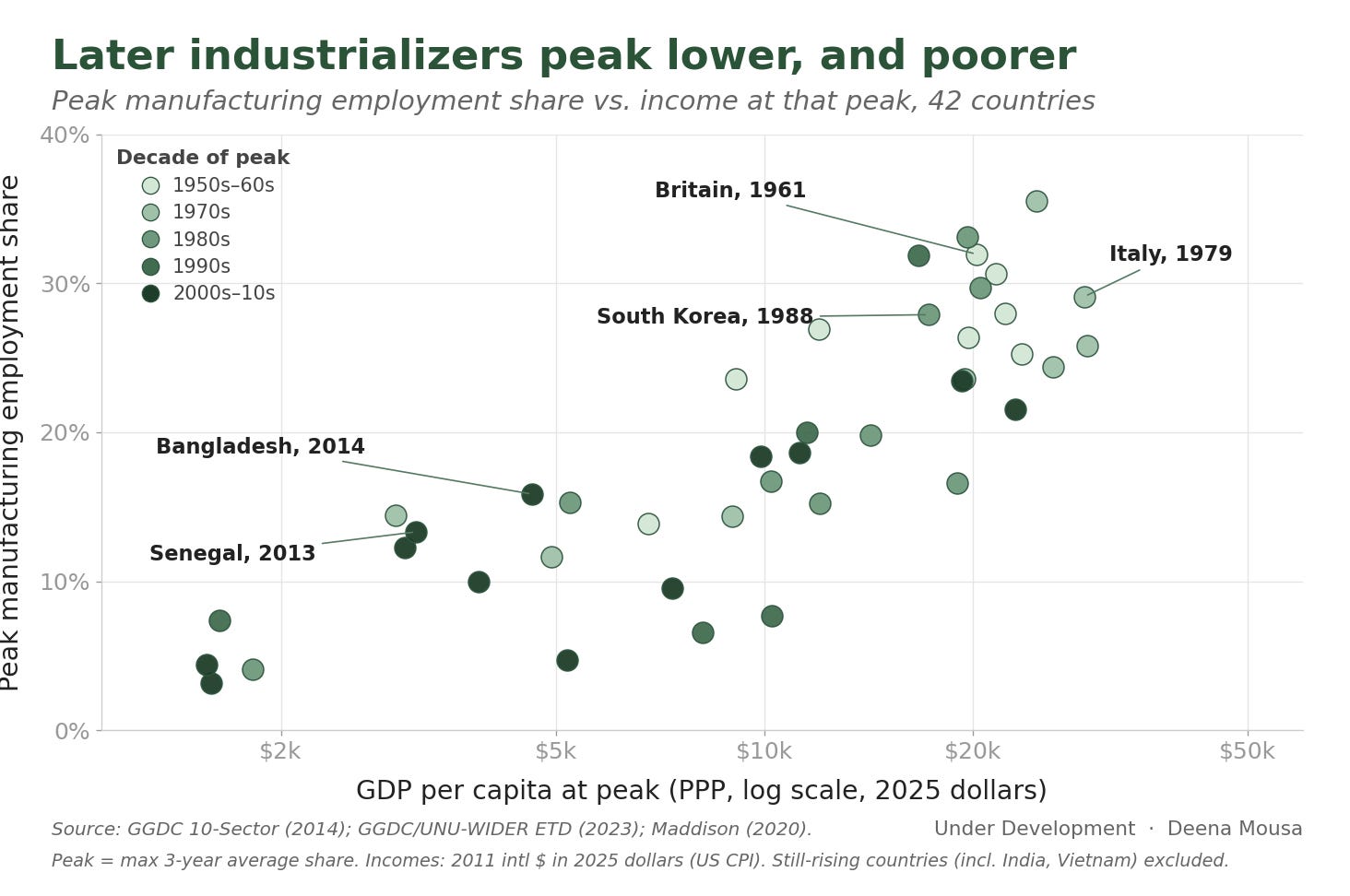
At first, this might sound like the story above of how countries develop - an industry gets more productive and needs to employ fewer people, who then move on to new, even more productive jobs. But in historical cases, manufacturing grew to a much larger percentage of the economy first, employing in some cases as much as a third of the workforce. The flattening or draw-down in employment in the sector was driven by labor becoming scarcer and more expensive, pushing factories to automate. By then, those out of a job were more educated and urban, and could be reabsorbed into a budding services sector. But as Bangladeshi factories automate much sooner, not enough growth has already happened for labor to become more expensive and more educated.
Unfortunately, even were the population primed to start creating service exports, that rung of the ladder is likely to vanish soon as well.
Offices without employees
The advent of the internet and cheap telecoms made it possible to export labor from one country to another, without shipping any material goods. Now, an accountant in Manila or a programmer in India could work for a customer in Ohio. India’s tech services industry earned $283 billion last year and currently employs 5.8 million people. In the Philippines, call centers and back offices gross $40 billion a year, which is over 8% of the country’s GDP, and employ 1.9 million people.
Unfortunately, though, the same traits that make a job possible to offshore — done entirely digitally, with clear outputs and verifiable quality — are also traits that make work especially automatable.
So, is AI actually destroying these jobs? If so, it hasn’t shown up in the top-level data yet. Philippine BPO revenue and employment both grew again last year, and India’s IT industry employs more people than ever. If you count existing jobs, nothing is happening.
New jobs are a different story, though. India’s top IT firms hired around 600,000 fresh graduates in FY2022 but only around 120,000 in FY2025. Some of that is the post-COVID hiring bubble deflating, but the composition is shifting too: workers under 30 have gone from 60% of the industry to 51% in the last three years. The Philippine industry added 135,000 new jobs in 2023, 120,000 in 2024, and 80,000 in 2025. On freelance platforms, where the effects are cleanest to measure, postings for writing and translation fell by a fifth to a third in the year after ChatGPT’s release.
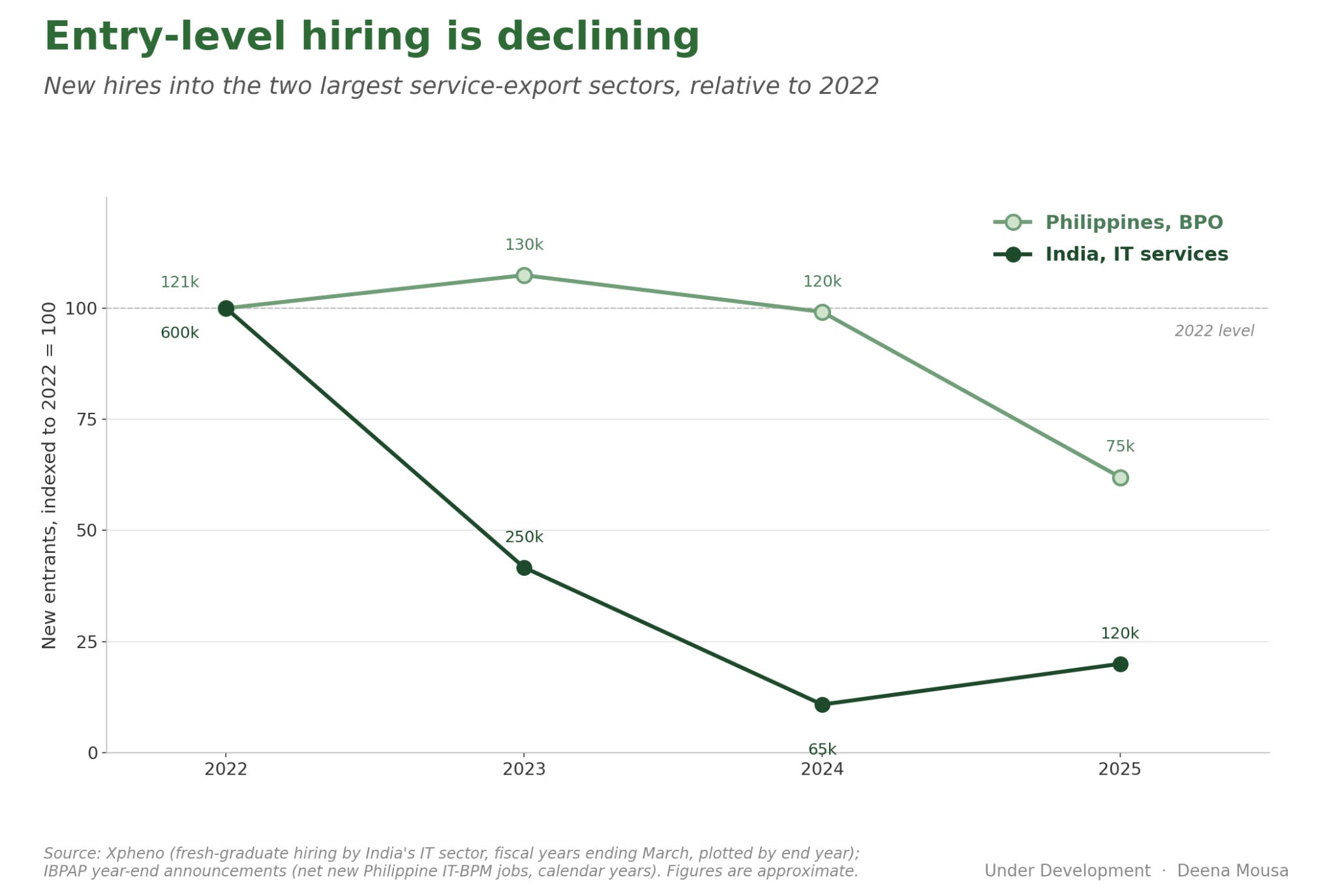
For a poor country, the ability to onboard new workers into a more productive, higher-paying sector is critical to the sector operating as an engine for growth, even if the overall earnings remain the same.
Will the cheapest labor win?
A strong counterargument to this pessimistic view is that even if AI can do a job well, if hiring a person to do it is cheaper than deploying an AI agent, then humans will keep those jobs. This is good news for those in low- and middle-income countries, who provide labor at a much lower cost than their counterparts in wealthier countries.
So far, evidence leans in favor of AI uplifting rather than replacing workers for the most part, and the lower the wages the longer this might be true. In a recent study, giving about 5,000 customer service agents an AI assistant raised the productivity of the newest workers by 34% while barely moving the most skilled. The pithy phrasing of this objection would be “don’t fear the AI, fear the cheaper worker using AI.”
The problem with this is that wages are static (and ideally increasing) while the cost of running AI at a fixed level of capability has been falling by roughly 10 to 50 times per year.

Even while humans keep those jobs, the alternative of automation will also set a ceiling on their earnings. For example, after ChatGPT launched in late 2022, posted hourly rates for translation work on Upwork fell by more than 20%. While cheaper cognition will expand total demand for those services, Jevons-style, this certainly doesn’t mean it’ll grow enough to compensate, especially for lower-skill work, or that humans will be needed to fulfill it.
In addition, the lowest-skill service work (routine tickets, translation, copy-editing) is most often exported and also the most likely to be automated first. In response, service exporters have started climbing the skill-chain, with fewer call center agents, and more analytics and engineering. But, reminiscent of the Bangladeshi garment sector, India’s tech revenue is growing at 6% a year while headcount grows at 2%. Though some of this is the unwinding of COVID-era over-hiring, it seems ambiguous whether all of it is. Models still hallucinate or make important mistakes, and regulators insist on having humans in the loop, but those frictions only slow the trend for as long as they exist.
Of course, cheaper services are very good for poor consumers, in that a clinic with no doctor benefits enormously from access to one in a phone (though, as I’ve written before, I expect the gains of AI to accrue less to LMICs than HICs), but this is separate from the question of overall economic growth.
What’s left to sell
For the last century, poor countries’ poverty was — in a narrow sense — their greatest asset. Low wages made their exports naturally competitive, earning business from the rich world. This has held true whether those exports were cocoa, garments, electronics, or code.
AI, however, might outcompete that cheap labor on price, reducing the cost of producing many of those exports enough to shut off this mechanism of growth entirely. Indicators like early-career hiring at India’s IT firms, net-new jobs in Manila, contract rates at major customers, and posted rates for various freelance work might help us see this trend early.
What might lower-income countries do next? In the next piece, I’ll discuss some alternate growth pathways that are often proposed in response to this concern, and how promising they might be.
Great piece!
Is there any non collapse ?
I think story is similar on high income countries as well with a lag ?
demand collapse ?