

Some great pieces this month that complicate the standard story about how AI will hit the labor market. A few highlights: humans aren’t passive, but rather adapt to technology as it develops; AI clearing one bottleneck usually just raises the value of the work in a related one; and the question of whether AI will replace jobs looks very different in countries that don’t have many of those jobs in the first place.
Endogenous Task Bundling, Skills and Automation - Joshua Gans, NBER Working Paper
It’s common for labor economists to measure AI’s wage effects by looking at the bundle of tasks a worker does, compute how exposed they are to AI, and regress wage changes on that exposure. But workers’ tasks aren’t fixed; they change in response to AI exposure. In this paper, Joshua builds a model where the priced bundle of human tasks is endogenous, allowing firms to choose whether to recombine remaining tasks into a generalist role or separate them out into specialist ones. This model, he shows, can result in directionally opposite estimates of wage effects compared to the traditional approach.
I like this paper because I find that often we take for granted the directional effect of AI on a particular outcome, without remembering that technology is interacting with a pre-existing, complicated system. We can’t project what will happen when jobs are exposed to AI without considering how employers and employees themselves will respond and adapt.
How Artificial Intelligence Shapes Science: Evidence from AlphaFold - Ryan R. Hill and Carolyn Stein, NBER Working Paper
Alphafold2 is a machine-learning model developed by DeepMind designed to predict a protein’s structure from its amino acid sequence. It was released alongside many structures it had predicted in July 2021. The authors of this paper use this as a natural experiment to look at how AI might affect scientific discovery and find that experimental research to determine the structure of proteins didn’t decline — that is, AlphaFold was not substituting for lab research.
That said, there was a significant increase in the use of ‘molecular replacement’, which is a faster method for solving experimental structures that uses a known similar structure as a starting template, many of them using AlphaFold predictions as the starting model. There was an increase in new research on previously-unsolved proteins, but this didn’t result in any visible spillover to drug discovery (yet), though that wouldn’t really be expected as AlphaFold largely plays a role in relatively early, basic scientific research.
This paper is a very interesting example of how looking at the bottlenecks that are and are not solved by AI can tell you how work might shift in response. In this case, AI lowered the cost of one thing (predicted structures), which did not kill demand for the complement (experimental structures) but did change which problems were more worth working on (previously-unstudied proteins become more tractable). This pattern is applicable to other fields too.
“The intelligence is plenty but the workers are few” - Daniel Björkegren
Daniel points out that LLMs have shifted from a tool primarily based on information to one that provides intelligence, and that low- and middle-income countries are less well-equipped to handle this. This is true both because they may not have the necessary inputs for advanced AI models (a reliable grid, digital data, and so on) and, more centrally, because they have fewer workers in skilled knowledge work.
I was really glad to read this post. I think it points to a big assumption in high-income country discourse that doesn’t apply to LMICs. In the US, we’re concerned about AI stealing jobs. But in one of the many countries with fewer than 1 doctor per 10,000 people the question is more about how AI can provide care to people whose counterfactual is ‘no doctor’ rather than a human one. It is true, though, that many of the bottlenecks to actually delivering this care (like last-mile infrastructure) unfortunately won’t be solved by AI directly.
“AI is exposing cracks in India’s growth story as it hits high-paying IT jobs” - CNBC
Bernstein’s India strategy team wrote an open letter to PM Modi, warning that India’s 10-15 million IT services and BPO workers are at risk of AI automation. They point out that gross IT hiring fell from ~230,000/year to 170,000 in the fiscal year ending March 2026. The government’s response, via IT minister Ashwini Vaishnaw, is the standard “upskilling and reskilling” line, but the analysts CNBC spoke to are skeptical the workforce can absorb that shift given India’s weak underlying education outcomes.
The potential service export bust seems to me like a key risk for middle-income countries, and a big threat to a potential economic development pathway. Regardless of mechanism (AI uplift, mix shift, tighter utilization), it’s also noteworthy that headcount is contracting while revenues are holding stable. Indian IT revenue and employment moved together for two decades, and FY26 is the first year where that’s apparently changed.
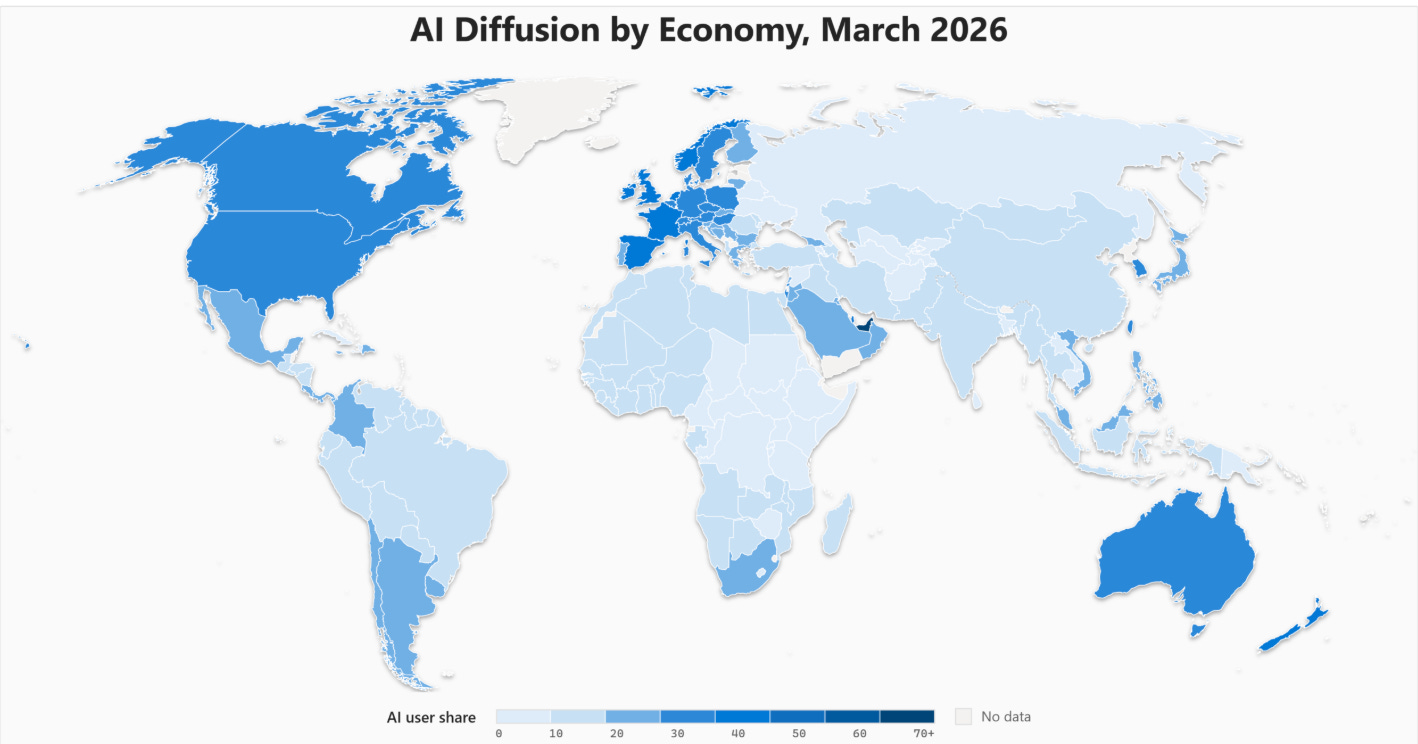
Global AI Diffusion Q1 2026 Trends and Insights - Microsoft AI Economy Institute
Microsoft’s Global AI Diffusion Report looks at the percent of Windows desktop users who’ve used a generative AI product during Q1 2026, then scales that up to an estimate for the share of the working-age population who have done so based on country-level desktop penetration and mobile-to-desktop ratios.
There’s an appreciable gap between the Global North (27.5%) and Global South (15.4%) though both feel pretty low if you are exposed to AI Twitter or the tech scene in a coastal US city.
“Language models are weird for the same reason human cultures are weird” - David Oks
David argues that LLMs’ propensity to adopt strange quirks, like an obsession with goblins or overuse of particular words that have become an AI ‘tell’, is actually something humans have done as well. When humans have succeeded at something without detailed feedback as to why, they might try to replicate everything about the successful action, including pieces of it that were incidental. One example: nixtamalization spread along with inert rituals like blowing on maize, because doing everything you were doing when successful is safer than trying to isolate the important piece. In fact, this type of behavior, David argues, is inherent to adaptive systems that learn and try to improve based on coarse feedback, like a thumbs up/down or a good/bad crop yield.
I really enjoyed this one because it took something we think of as very distinctly LLM-y and unintuitively pointed out that it’s actually quite human at its core.